AI Feedback Analysis for Operational Decisions
November 23, 2026
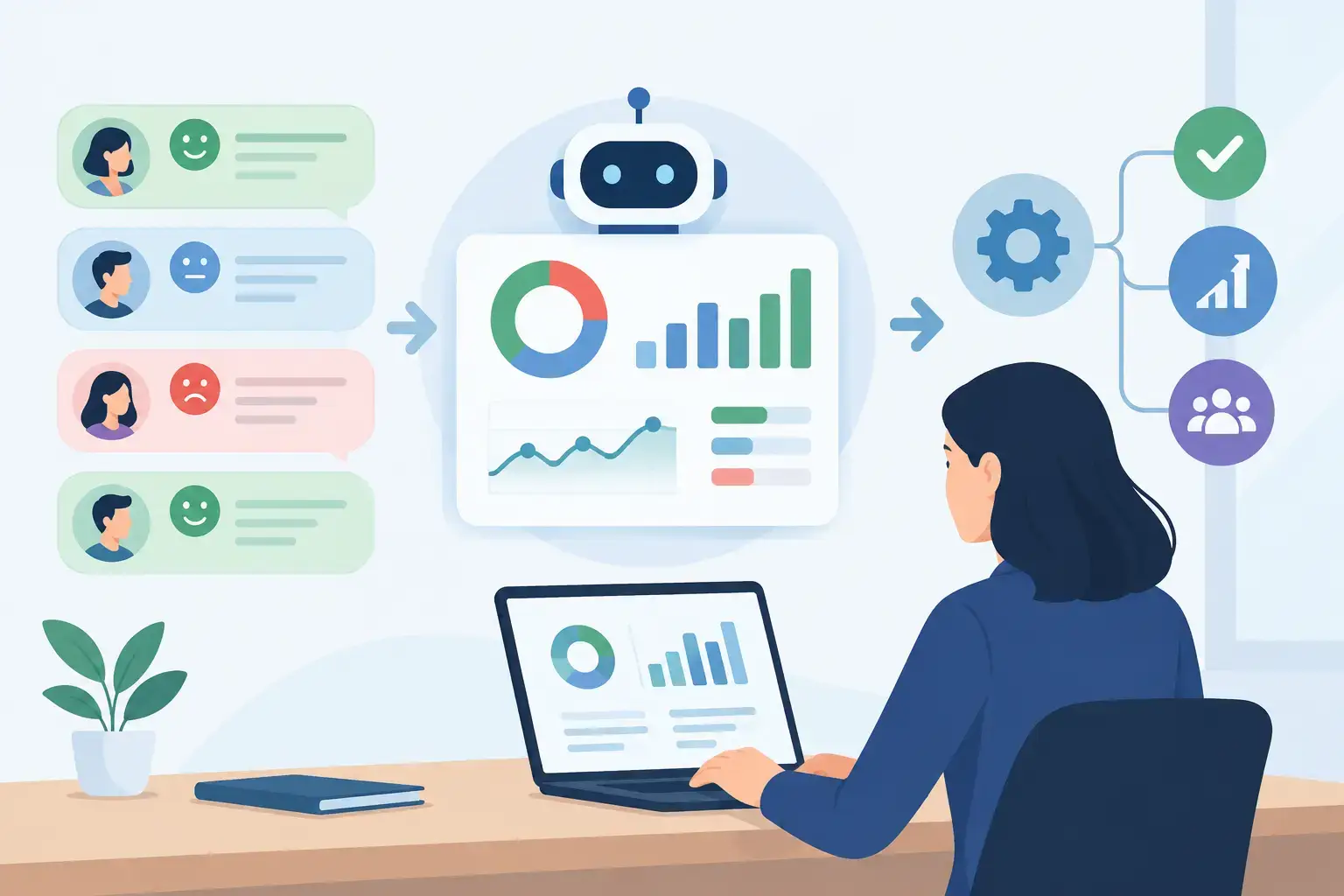
A service leader may have 3,000 survey comments, a shared inbox full of escalations, and work-order notes describing the same failure in different language. The problem is rarely a lack of feedback. It is the lack of a reliable way to turn that feedback into an operational decision. AI feedback analysis can reduce that gap by organizing high-volume qualitative input into patterns teams can review, verify, and act on.
The value is not in asking an AI system to produce a polished summary of customer sentiment. It is in creating a disciplined process for finding recurring issues, connecting them to the right operational owner, and tracking whether the organization resolved the underlying cause.
What AI Feedback Analysis Should Do
AI feedback analysis applies machine learning and language models to unstructured feedback such as open-ended survey responses, complaint narratives, support records, call transcripts, email messages, and field-service notes. It can identify topics, classify comments, detect emerging themes, summarize large collections of text, and surface representative examples.
For an operations or customer-experience team, this work should answer practical questions: What are people reporting? Which issue is growing? Where in the journey does it occur? Which team owns the root cause? What evidence supports the priority?
That distinction matters. A simple sentiment score can signal that customers are unhappy, but it does not explain whether the issue is billing clarity, appointment availability, damaged shipments, confusing communications, or an unresolved service case. Leaders need a usable classification structure and enough context to decide what changes next.
From broad themes to operational categories
The first output from AI is often a broad theme, such as “communication” or “service quality.” Broad themes are useful for orientation but are too vague for an Action Backlog.
A stronger approach uses a hierarchy. A comment about a delayed technician could be classified under service delivery, then scheduling, then missed arrival window. A comment about an invoice could fall under billing, then charges, then unexpected fee. That structure lets teams measure recurring issues at a level where someone can own the response.
AI can accelerate the initial classification, especially when feedback volumes are high and language varies widely. Human reviewers still need to define the categories, test whether they are meaningful, and refine them when operations change. The taxonomy is not a technical detail. It is the bridge between raw language and accountable work.
Why a Single Summary Is Not Enough
Generative AI is effective at reading and condensing text. That can save substantial time during early review. But a summary alone is a weak operating record because it can blur important differences, omit low-frequency but serious complaints, or make a pattern sound more certain than the source data supports.
A useful feedback program preserves traceability. Every reported theme should lead back to the underlying records: the comments, messages, transcript excerpts, or notes that support it. Teams should be able to inspect sample responses, compare results by location or customer segment, and see the volume and direction of a theme over time.
This is particularly important when decisions affect staffing, policies, vendor performance, product changes, or customer recovery. An executive may accept a concise insight view, but the analysts and operators supporting that decision need access to the evidence beneath it.
AI output also needs controls. Similar phrases can carry different meanings depending on context. “The agent was fast” may be praise for efficient service or frustration that the conversation ended too quickly. Comments can include sarcasm, incomplete details, copied boilerplate, and references that only make sense inside a specific business process. No model removes the need for quality review.
A Practical Workflow for AI Feedback Analysis
The most effective workflow begins before analysis. Start with the operational decision the organization needs to make. If the goal is to reduce repeat contacts, for example, the analysis should distinguish between customers who contacted support again because an issue was unresolved and those who had a separate question. If the goal is to improve employee retention, categories should reflect workplace conditions leaders can influence.
1. Bring related feedback into a common view
Feedback is usually fragmented. Survey platforms hold open-ended responses. Customer-service systems contain case notes. Complaint records may be stored separately. Operations teams often maintain work-order histories, while quality teams review calls in another system.
Analyzing each source alone produces partial answers. The organization may see complaints rising without recognizing that the same issue appears in survey comments and support contacts. Consolidating sources makes it possible to compare signals and identify patterns that deserve investigation.
Common data fields should travel with the text whenever possible. Dates, locations, product lines, customer segments, case types, service teams, and journey stages turn a generic theme into a decision-ready finding. A classification that shows “appointment problems” is helpful. A classification showing appointment problems concentrated in one region, during a specific scheduling process, is actionable.
2. Establish a category framework before automating at scale
Allowing AI to generate a new set of themes for every analysis creates inconsistency. It becomes difficult to compare this month with last month or determine whether a reported increase is real rather than a labeling change.
Define a manageable category framework based on the issues your organization routinely needs to manage. Include a clear definition for each category, examples of what belongs, and rules for overlaps. Some records will warrant multiple labels. A complaint about a late delivery and poor status updates may belong to both fulfillment and communication.
The framework should be stable enough for reporting but flexible enough to evolve. New issues emerge, products change, and business language shifts. Review category performance periodically rather than treating the first taxonomy as permanent.
3. Use AI to classify, summarize, and prioritize
Once the framework exists, AI can apply classifications across large volumes of feedback and generate concise descriptions of what people are saying within each category. It can also identify unusual changes, cluster similar language, and surface records that may need immediate review.
Prioritization should not rely on volume alone. A relatively small number of comments about a safety concern, compliance issue, or severe service failure may require faster attention than a common but minor inconvenience. Consider frequency alongside severity, trend direction, affected audience, operational risk, and the organization’s ability to intervene.
This is where guided analysis is useful. It gives nontechnical users a repeatable path from a question to supporting evidence without requiring them to manually prepare every data set or interpret model output in isolation.
4. Validate patterns with people closest to the work
Analysts can see patterns in the data. Frontline managers and process owners can explain why those patterns may be occurring. Both perspectives are necessary.
Review high-impact findings with the teams responsible for the relevant experience. Ask whether the classification reflects the real process, whether there are known changes that explain the trend, and what additional evidence is needed. This step often reveals that an apparent customer problem is caused by a policy exception, a system outage, a training gap, or a handoff between teams.
Validation is not a reason to delay every decision. It is a way to separate credible operational signals from misleading correlations.
5. Convert findings into owned work
Feedback analysis loses value when it ends in a dashboard. Each priority issue should move into a defined action process with an owner, due date, expected outcome, and status. The action may be an investigation, process correction, training update, customer communication change, or product improvement.
A platform such as StatQuestions supports this lifecycle by centralizing feedback records, applying classifications, presenting evidence in dashboards and shared insight views, and moving approved priorities into an Action Backlog. The goal is continuity between the comment a customer wrote and the work a team agreed to complete.
Where AI Can Mislead Teams
AI can create a false sense of precision. A model may assign a label confidently even when the comment is ambiguous. It may overemphasize frequently repeated language, especially when survey prompts or case templates influence how people write. It can also reflect bias in the examples used to train or configure the system.
Treat model outputs as structured assistance, not unquestioned fact. Monitor classification accuracy using reviewed samples. Track how often categories are corrected. Keep a process for handling sensitive records, personally identifiable information, and feedback involving allegations or urgent harm.
The right level of human review depends on risk. A team using AI to organize low-risk product suggestions may sample results regularly. A team analyzing regulated complaints, employee concerns, or quality incidents may require stricter review before findings are distributed or used in decisions.
Measure Whether the Analysis Changed Anything
The success measure is not the number of comments processed or themes generated. It is whether analysis helps the organization make better, faster decisions and determine if interventions worked.
Track operational measures tied to the issue being addressed. For a scheduling problem, that might include missed appointment rates, repeat contacts, or comments mentioning arrival windows. For billing confusion, it could include dispute reasons, payment-related contacts, and the share of feedback classified under unclear charges. Feedback should remain part of the measurement after an action is launched, not just the evidence used to approve it.
The most useful AI feedback analysis creates a working line of sight: from a person’s words, to a verified pattern, to a named owner, to a measurable operational change. That is where qualitative feedback becomes a practical management system rather than another report waiting to be read.