
Employee Feedback Analytics Software That Drives Action
September 21, 2026
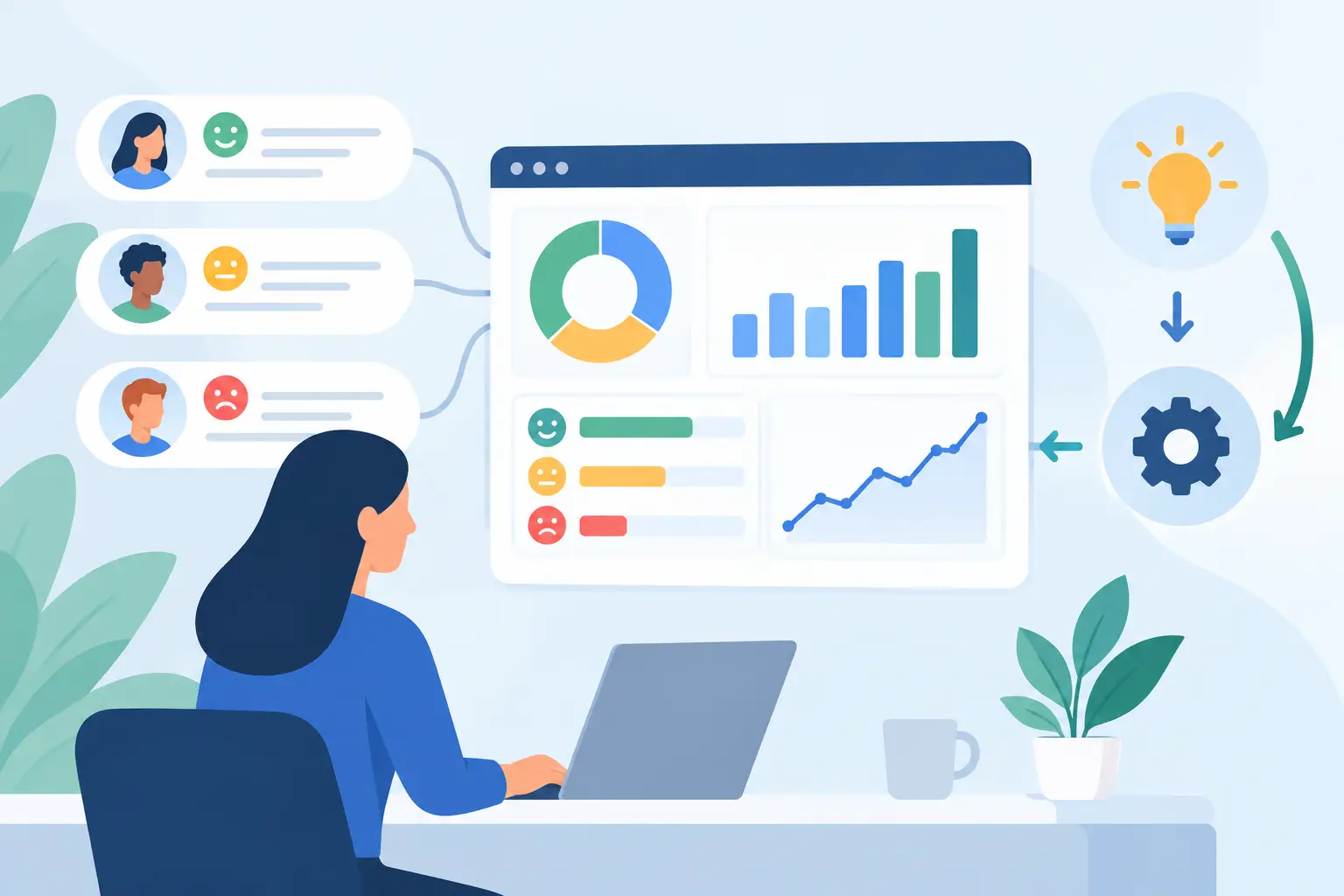
A low engagement score is not an action plan. Neither are hundreds of open-ended survey comments, exit-interview notes, manager emails, and HR case records stored in separate systems. Employee feedback analytics software gives employee-experience and operations teams a disciplined way to bring those signals together, identify what is driving them, and assign follow-through.
The distinction matters. Many organizations can collect employee feedback. Far fewer can explain why a score changed, determine which teams or locations are affected, connect recurring themes to operational conditions, and verify that someone acted on the finding. The value of analytics is not a better chart. It is a repeatable path from feedback to decisions and accountable action.
What employee feedback analytics software should do
Employee feedback arrives through more channels than the annual engagement survey. It appears in pulse surveys, open-text responses, exit interviews, HR requests, manager escalations, internal emails, performance conversations, safety reports, work-order notes, and employee relations records. Each source may hold part of the story, but each usually has its own owner, format, and reporting process.
A useful platform starts by centralizing those inputs without forcing teams to abandon every existing collection tool. Survey data should sit beside qualitative records from operational and HR-adjacent systems. Structured fields such as department, tenure, role, worksite, manager, shift, and employment status provide the context needed to compare patterns responsibly.
From there, the system should organize unstructured text into consistent classifications. For example, comments about scheduling, short staffing, overtime, shift swaps, and coverage gaps may belong to a workforce planning theme. Comments about unclear priorities, changing procedures, and inconsistent handoffs may point to communication or process design. Classification does not replace human judgment. It makes large volumes of feedback reviewable and comparable.
The final requirement is operational: findings must move into work. Teams need a place to document a root cause, define an action, assign an owner, set a due date, and track status. Without that layer, employee listening becomes a recurring reporting exercise with no reliable mechanism for improvement.
Move beyond engagement scores
Engagement scores are useful indicators, particularly when measured consistently over time. They can show that confidence in leadership declined, perceptions of career growth differ by location, or workload concerns are increasing. But scores rarely explain the underlying condition on their own.
An employee feedback analytics workflow should allow users to move from a score to the supporting evidence. If one business unit reports a decline in confidence, analysts should be able to examine the themes within open-ended comments, compare them with prior periods, and segment results by relevant employee groups. The goal is not to search for a convenient explanation. It is to test whether the qualitative evidence supports a specific operational hypothesis.
Consider a distribution operation where survey scores indicate rising workload pressure. Comment analysis may reveal that employees are not objecting to the amount of work in general. They may be describing late schedule changes, unavailable equipment, unclear escalation paths, or a persistent gap between staffing plans and daily volume. Those are different problems, owned by different leaders, and they require different actions.
This is why text analysis needs to remain connected to source records. Aggregated themes are valuable, but leaders should be able to review representative comments, assess the language employees actually used, and understand where the pattern is concentrated. Context protects teams from acting on an oversimplified label.
Build an employee feedback workflow, not another dashboard
Dashboards help leaders see what deserves attention. They do not resolve the common handoff problem between insight and execution. A complete workflow connects data sources, analysis, decisions, and actions in one managed process.
Centralize feedback with usable context
Begin with the sources that are already producing meaningful employee signals. Surveys are often the logical starting point, but they should not be the endpoint. Bring in the sources that can validate or clarify a theme, such as HR service records, internal complaint logs, manager feedback, or operational notes.
Data governance should be established before broad access is granted. Employee feedback can include sensitive information, and small-group reporting can create confidentiality risks. Define access by role, apply minimum response thresholds where appropriate, separate personally identifiable information from general reporting, and document how sensitive comments are reviewed. More data is not automatically better if teams cannot use it safely.
Classify themes consistently
A stable classification framework gives the organization a shared language for employee feedback. Categories might include manager effectiveness, workload, safety, compensation, tools, policy, career development, communication, inclusion, and scheduling. The right library depends on the organization and should evolve as new issues emerge.
Consistency matters because it allows comparison across sources and periods. If survey comments call an issue “training” while complaint records classify the same problem as “process confusion,” the organization may miss the scale of the pattern. A controlled taxonomy helps teams connect related evidence while preserving the original text and source information.
Automation can accelerate this work, especially for high feedback volumes. It should be treated as a first-pass capability, not an unquestioned authority. Teams need a way to review classifications, correct edge cases, identify emerging topics, and maintain definitions over time. Ambiguous language is common in employee feedback, and operational context often changes its meaning.
Use guided analysis to test root causes
Once a theme appears, move beyond the question, “How many comments mentioned it?” Ask where the issue is occurring, when it increased, who is affected, and what other signals changed alongside it.
Guided Analysis should lead users through these questions in a consistent order. Compare affected and unaffected groups. Review trends before and after a policy, staffing, leadership, or process change. Examine related categories. Read source comments. Then document the evidence for and against the proposed root cause.
The answer may be straightforward, but it often is not. A concern labeled as poor communication may stem from frequent policy changes, insufficient manager briefing, an inaccessible knowledge base, or inconsistent implementation between locations. The purpose of root-cause analysis is to prevent organizations from treating every symptom with another communication campaign.
Turn findings into owned actions
An Action Backlog makes feedback work visible after the meeting ends. Each action should identify the issue, evidence, accountable owner, expected outcome, due date, and status. Where possible, it should also define a leading indicator that shows whether the intervention is taking hold before the next engagement survey.
For a scheduling concern, the action may be to publish schedules earlier, establish an escalation process for late changes, and monitor exceptions by site. For a manager communication issue, the action may include a briefing cadence, updated manager materials, and a measurement plan that combines pulse feedback with operational compliance data.
Not every finding warrants a large program. Some issues are local and should be resolved by a site or department leader. Others reveal a policy or system problem that requires enterprise ownership. The software should help teams distinguish between those levels instead of presenting every theme as equally urgent.
Measure whether action changed the employee experience
Closing the loop means more than telling employees their feedback was heard. It means reporting what the organization learned, what it decided to change, and what happened next. Specificity builds more credibility than broad promises.
Measurement should combine perception and operational evidence. A follow-up pulse can test whether employees experience fewer schedule disruptions. HR or operations data can show whether late schedule changes actually declined. Comments can reveal whether the change solved the original problem or introduced a new friction point.
Be cautious with attribution. If scores improve after an intervention, the action may have contributed, but other changes may also be involved. Stronger teams record the timing, scope, and ownership of actions so they can make a more credible assessment over time. They also recognize when results differ by group rather than declaring a company-wide success too early.
Selecting the right platform
When evaluating employee feedback analytics software, focus on the workflow your team needs to run every month, not only the appearance of the dashboard. Ask whether the platform can ingest existing feedback sources, manage unstructured text at scale, preserve source-level context, support controlled classifications, and segment data without compromising confidentiality.
Also examine what happens after analysis. Can teams document root causes, create assigned actions, monitor completion, and share a decision-ready view with leaders? Can a nontechnical manager investigate a pattern through guided analysis, while analysts retain the control and detail needed for deeper review? These capabilities determine whether the platform becomes a working system or another reporting destination.
StatQuestions is designed around that connected lifecycle: centralizing feedback data, organizing qualitative evidence, supporting root-cause analysis, and managing follow-through through dashboards, shared insights, and an Action Backlog.
Employee feedback becomes more credible when people can see a visible connection between what they reported and what the organization changed. The most useful system is the one that helps teams make that connection consistently, even when the evidence begins as messy, fragmented text.