How to Build Complaint Taxonomy for Clearer Triage
November 27, 2026
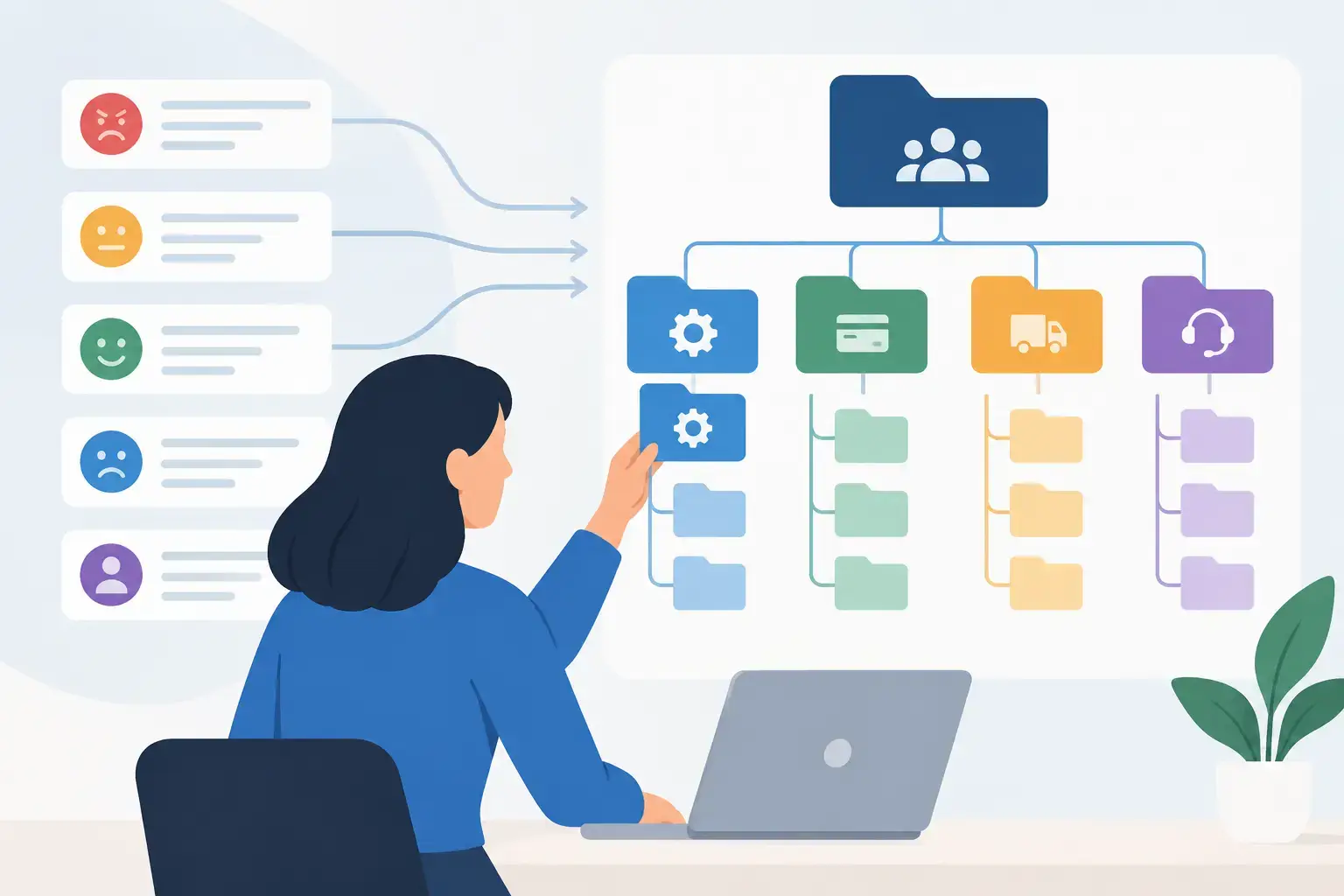
A complaint inbox becomes hard to manage long before volume becomes extreme. The real problem is inconsistency: one team labels an issue as billing, another calls it a payment failure, and a third routes it to general service. Learning how to build complaint taxonomy gives every complaint a common structure, so teams can distinguish isolated incidents from recurring operational failures and assign the right response.
A useful taxonomy is not a long list of labels. It is a controlled decision system for organizing complaint content across emails, call transcripts, surveys, case records, work-order notes, and customer-experience platforms. It should help people answer three operational questions: What happened? Why did it happen? Who is responsible for fixing it?
Start with the operational decision
Do not begin by reading complaints and generating as many categories as possible. That approach produces a detailed but unstable label set that no one can apply consistently. Begin with the decisions the taxonomy must support.
For a service organization, leaders may need to identify whether complaints stem from appointment availability, technician conduct, incomplete work, communication gaps, or invoicing. A product team may need to separate defects from delivery delays, unclear instructions, account-access failures, and expectation gaps. The categories should make those decisions easier, not merely describe the language customers use.
Write down the users of the taxonomy and the decisions each group needs to make. Frontline teams need routing and urgency. Operations leaders need recurring failure patterns. Executives need a concise view of systemic risk, ownership, and progress. If a category does not improve a decision, it probably does not belong in the model.
Define the levels of your complaint taxonomy
Most organizations need more than one field to describe a complaint. A single flat category forces too much meaning into one label. A layered model preserves context while keeping reporting manageable.
A practical complaint taxonomy often includes these five dimensions:
- Complaint domain identifies the broad area, such as product, service delivery, billing, account management, communication, or policy.
- Issue type identifies the specific failure, such as delayed delivery, incorrect charge, unprofessional interaction, damaged item, or unresolved request.
- Root cause captures the underlying contributor when known, such as training, process design, system defect, vendor dependency, staffing, or unclear policy.
- Impact or severity records the consequence, including financial loss, service interruption, safety concern, repeat contact, or reputational risk.
- Ownership assigns the team or role accountable for investigation and corrective action.
This structure separates the visible complaint from the cause. For example, a customer may complain about a missed appointment. The issue type is missed appointment, but the root cause could be scheduling capacity, an inaccurate address, a third-party dispatch failure, or a communication breakdown. Treating all missed appointments as one operational problem can send improvement work in the wrong direction.
Not every record will have a confirmed root cause at intake. That is expected. Use values such as pending investigation or insufficient evidence rather than forcing a guess. The taxonomy should preserve analytical integrity, not create false certainty.
Build categories from real complaint language
Pull a representative sample of existing complaints before designing labels. Include recent records and records from different channels, regions, products, or business units. A small but varied sample is more useful than reviewing hundreds of near-identical cases from one source.
Read the complaints for repeated situations, not repeated words. Customers may say the technician never came, nobody showed up, or I waited all day. These are different expressions of the same issue type. Your taxonomy should normalize the operational meaning while retaining original text for review.
As you group records, look for the point at which categories become genuinely distinct. Billing error and billing explanation may both sit within billing, but they require different responses. By contrast, late invoice and invoice received after the service date may not need separate labels if they result in the same investigation and action path.
A good test is this: if two labels would be routed to the same owner, investigated the same way, and resolved through the same corrective action, consider combining them. If they differ in any of those three ways, separate categories may be justified.
Use definitions, inclusions, and exclusions
Every category needs a short definition. Without one, labels gradually change meaning as different people classify records.
For each issue type, document what belongs in the category, what does not, and examples of typical wording. A category called poor communication, for instance, is too broad unless it defines whether it includes missing updates, conflicting information, delayed responses, or staff tone. Those may be separate issue types depending on the action each requires.
Definitions also reduce confusion between related categories. Consider the difference between service not completed and service completed incorrectly. Both are service-delivery complaints, but one signals a failure to perform while the other signals a quality failure. Reporting them together may conceal a meaningful pattern.
Keep the structure usable at the point of intake
A taxonomy can be analytically sound and still fail if it is too difficult for people or systems to apply. Intake classification should require enough detail to route and measure the complaint, but not a lengthy investigation before work begins.
For most teams, the first-pass classifier should select a domain, issue type, severity, and owner. Root cause can be assigned later through Guided Analysis, case review, or a formal root-cause-analysis process. This division supports faster triage while protecting the quality of causal reporting.
Avoid uncontrolled tags as a substitute for taxonomy. Free-form tags can help capture temporary themes or local context, but they fragment reporting when they become the primary classification method. If a tag becomes common and supports a recurring decision, evaluate whether it deserves a governed taxonomy category.
Design for multiple complaint sources
Complaints rarely arrive in one clean system. They appear in customer emails, support records, post-service surveys, call transcripts, review responses, escalation notes, and operational logs. The taxonomy needs to work across these sources without assuming that every record contains the same information.
An email may contain a detailed narrative but no account identifier. A survey response may reveal dissatisfaction without a formal request for remediation. A call transcript may show a complaint that an agent never logged as a case. Define minimum evidence rules for each field so the team knows when to classify, when to mark unknown, and when to request more information.
This is where a centralized Feedback Intelligence Platform can reduce manual reconciliation. StatQuestions can organize complaints alongside other feedback sources, apply consistent classifications, and surface patterns in a Complaint Dashboard without disconnecting insight from ownership and follow-up.
Test the taxonomy before scaling it
Before applying the taxonomy across all historical and incoming records, test it with a group of users. Give the same set of complaints to several classifiers and compare their choices. Consistent agreement indicates that the definitions are clear enough. Frequent disagreement usually points to overlapping categories, vague definitions, missing options, or unclear classification rules.
Review disagreements constructively. The goal is not to identify who classified a complaint incorrectly. It is to improve the system so the next person can make the same decision with less interpretation.
Pay close attention to catch-all categories such as other, general concern, or miscellaneous. These are useful as temporary holding areas, but a growing other category is a signal. It may indicate that the taxonomy is missing a meaningful issue type, or that people cannot find the appropriate category quickly enough.
Connect categories to accountability and action
Taxonomy becomes operationally valuable when categories connect to a clear workflow. Each high-level issue type should have an accountable owner, an expected investigation path, and criteria for escalation. High-severity complaints may require immediate service recovery, while recurring lower-severity issues may enter an Action Backlog for process improvement.
Track more than complaint counts. Measure volume by issue type, severity distribution, repeat-complaint patterns, time to assignment, time to resolution, root-cause confirmation rate, and the status of corrective actions. A decline in one category can be encouraging, but it may also reflect changes in intake behavior or classification. Review the underlying records before declaring success.
The most useful reports pair frequency with consequence. A relatively uncommon issue involving safety, account access, or substantial customer effort may deserve more attention than a common but low-impact question. Taxonomy should help leaders prioritize based on evidence rather than the loudest individual complaint.
Govern the taxonomy as a living system
A complaint taxonomy needs an owner and a review cadence. Products change, policies change, service models change, and new failure modes appear. Without governance, teams either force new issues into old labels or create uncontrolled alternatives outside the model.
Review the taxonomy quarterly or when major operational changes occur. Add a category only when there is enough evidence that it represents a distinct, actionable pattern. Retire or merge categories that no longer support decisions. Keep a change log so trend reporting remains interpretable over time.
The goal is not to classify every sentence perfectly. It is to give the organization a reliable shared language for turning complaint narratives into triage, root-cause investigation, and accountable improvement. When the taxonomy reflects how work is actually owned and corrected, complaints stop being scattered anecdotes and become a practical source of operational direction.