Employee Feedback Analytics That Drives Action
October 22, 2026
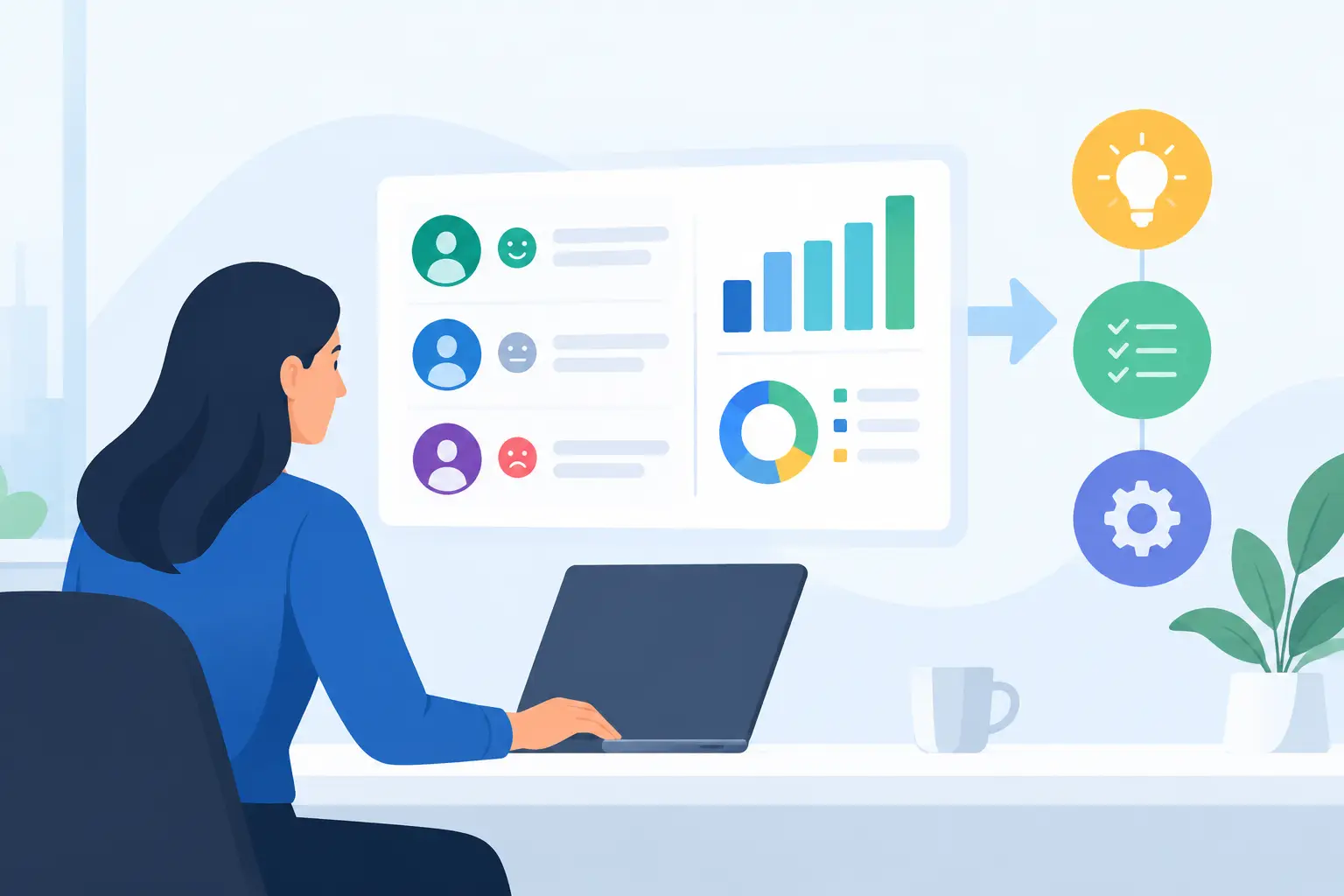
An annual engagement score can tell leadership that something is wrong. It rarely tells a manager which team is affected, what employees are experiencing, who owns the response, or whether the issue improved after action was taken. Employee feedback analytics closes that gap by turning dispersed comments, survey responses, emails, HR case notes, and operational records into an organized decision process.
For employee-experience and operations leaders, the objective is not a more polished dashboard. It is a repeatable way to identify issues early, establish root causes, assign work, and verify that corrective actions changed the employee experience.
What employee feedback analytics should produce
Employee feedback analytics is the process of collecting, organizing, analyzing, and acting on workforce feedback. It combines structured data, such as survey ratings and multiple-choice selections, with unstructured data, such as open-text comments, manager notes, exit interview summaries, and inbox messages.
The distinction matters because the most useful signals often sit outside a survey score. A declining confidence rating may indicate a broad concern, while written comments reveal whether employees are reacting to inconsistent scheduling, unclear role expectations, broken equipment, staffing gaps, or a specific leadership behavior.
A useful feedback program should produce four operational outputs:
- A clear view of recurring themes and their volume over time.
- Segment-level evidence showing where an issue is concentrated.
- Root-cause hypotheses supported by actual employee language and related operational data.
- An accountable action backlog with owners, due dates, status, and a method for measuring results.
Without the final output, analytics becomes observation. Teams can accurately describe a problem for months without changing the conditions that created it.
Why survey reporting alone falls short
Surveys remain valuable, particularly for measuring sentiment consistently over time. They provide a common baseline and can help leaders compare locations, functions, tenure groups, or managers. But surveys are only one feedback source, and treating them as the entire employee listening system creates blind spots.
Employees often share operational problems through channels that were not designed for analysis. They mention workload in a message to HR, report a safety concern in a work-order note, describe a scheduling conflict to a supervisor, or explain a resignation in an exit interview. When these records remain in separate systems, leaders see fragments of the employee experience rather than the full pattern.
Standalone survey tools can also encourage a narrow workflow: launch survey, export responses, review comments, present findings, repeat next quarter. That cycle produces insight, but it does not consistently connect feedback to work management. Generic business-intelligence tools have the opposite challenge. They can visualize data well, yet they often require substantial manual preparation before qualitative feedback is classified, interpreted, and connected to action owners.
The better approach is to centralize employee feedback data at the source, regardless of whether it began as a survey response, email, complaint, case record, or operations note.
Build a feedback data foundation before analyzing trends
Employee feedback analytics is only as reliable as the underlying data structure. Before interpreting a trend, establish a consistent way to bring sources together and retain the context required for action.
Connect feedback to operating context
A comment that says, “We never have enough coverage on weekends,” is more useful when it can be analyzed alongside location, department, shift, role, tenure, date, staffing levels, and relevant service metrics. Context does not mean collecting every available employee attribute. It means preserving the fields that help the organization distinguish a localized operating issue from an enterprise-wide concern.
Use a practical data model. For each feedback record, capture the source, date, audience or respondent group, business unit, relevant project, sentiment where appropriate, and assigned categories. Keep employee privacy and access controls central to the design. Not every leader should have access to raw comments, particularly when feedback could identify an individual or involve a sensitive employee relations matter.
Create a controlled classification system
Categories make qualitative feedback measurable. A controlled library might include themes such as scheduling, workload, manager communication, compensation, career growth, training, tools, safety, policy, and workplace culture. Each major theme can then be classified into more specific issues, such as “last-minute schedule changes” or “insufficient onboarding materials.”
The classification model should be detailed enough to guide action but not so detailed that teams cannot apply it consistently. A taxonomy with 15 usable categories is often more valuable than one with 150 categories that nobody maintains.
Review categories on a set cadence. New issues emerge, terminology changes, and operational teams may use language that differs from HR language. A living root-cause-analysis library helps preserve consistency while allowing the model to reflect the business as it operates.
Analyze volume, severity, and distribution together
A high-volume theme is not automatically the top priority. Some issues generate many comments because they are easy to mention, while a lower-volume issue may create serious retention, compliance, safety, or service risks. Strong analysis considers volume, severity, direction, and distribution at the same time.
Start by asking whether a theme is increasing, stable, or declining. Then identify where it is concentrated. If complaints about workload increase only in a single region, a local staffing decision may be the most likely explanation. If they increase across multiple departments after a policy change, leadership should investigate a broader cause.
Segment analysis requires care. Small groups can create misleading percentages and may introduce confidentiality concerns. Set minimum reporting thresholds, suppress results where anonymity cannot be protected, and avoid treating a handful of comments as proof of a system-wide issue. Conversely, do not dismiss a small group if the feedback suggests a serious risk.
Employee comments should be read alongside the classifications. Text analysis can identify themes at scale, but leaders still need representative verbatim feedback to understand the experience behind the label. “Manager communication” could refer to unclear priorities, lack of recognition, inconsistent policy enforcement, or a manager who does not respond to urgent messages. Those require different interventions.
Move from themes to root causes
The most common failure in feedback programs is stopping at a theme. “Employees want better communication” is not a root cause, and it is not an action plan. It is a starting point for investigation.
For each priority theme, ask what conditions create the experience, where those conditions occur, and what evidence supports the explanation. A workload issue, for example, may be driven by vacancy rates, inefficient processes, uneven case distribution, seasonal demand, inadequate software, or unclear escalation rules. The same survey item can point to entirely different root causes across teams.
Guided Analysis helps teams apply a consistent sequence: identify the pattern, review supporting records, test likely causes against operational data, document the finding, and define the action. This creates a record of why a decision was made, not just what the decision was.
Root-cause work also benefits from disagreement. HR may see a culture issue while operations sees a capacity issue. Rather than forcing an early conclusion, document both hypotheses and identify the evidence needed to test them. Feedback intelligence is strongest when it reduces opinion-based debates rather than simply giving one function a more persuasive chart.
Turn findings into an accountable Action Backlog
Employees lose trust when they are repeatedly asked for input and cannot see a response. The remedy is not to promise that every suggestion will be implemented. It is to demonstrate that meaningful feedback enters a visible decision and action process.
Every prioritized issue should become an action record with a defined problem statement, business area, accountable owner, due date, expected outcome, and status. Actions should be specific enough to be managed. “Improve scheduling” is too broad. “Publish schedules 14 days in advance for the pilot locations and measure late-change volume weekly” can be assigned, monitored, and evaluated.
A centralized Action Backlog makes dependencies visible. An employee-experience leader may own the feedback program, but the corrective action could sit with workforce planning, IT, facilities, operations, or a local manager. Shared insight views allow stakeholders to see the evidence, decision rationale, and progress without circulating disconnected slide decks and spreadsheet versions.
Not every issue warrants immediate remediation. Some require more research, budget approval, policy review, or a decision not to act. Record that outcome as well. A documented decision is better than feedback disappearing into a reporting process.
Measure whether action changed the experience
Action completion is not proof of impact. After implementing a change, monitor both feedback and operating measures that should move if the intervention worked. A scheduling initiative might be evaluated through comments about predictability, schedule-change rates, absenteeism, overtime, and retention in the affected group.
Set a realistic measurement window. Some changes, such as clearer supervisor communications, may affect sentiment quickly. Career-pathing changes may take several months before employees experience a meaningful difference. Be explicit about what success looks like before the action begins.
This is where an integrated platform such as StatQuestions can help teams maintain continuity from data ingestion through classification, analysis, action management, and reporting. The goal is not to automate judgment. It is to reduce the manual fragmentation that prevents good judgment from reaching the people responsible for execution.
Make feedback a management system, not an event
The most effective employee listening programs operate on a rhythm. Teams ingest feedback continuously or at regular intervals, review emerging themes, investigate priority issues, update action status, and communicate decisions to the people affected. Annual surveys can remain part of that rhythm, but they should not be the only moment when employee experience receives attention.
Start with one high-value use case, such as onboarding feedback, frontline scheduling, manager effectiveness, or voluntary turnover. Build the classifications, governance, and action workflow around that problem first. Once leaders can see a reliable path from employee input to accountable improvement, expanding the system becomes far easier.
Employees do not need leaders to have an instant answer to every concern. They need evidence that feedback is heard, evaluated in context, and converted into decisions that someone is responsible for carrying through.